Architecture
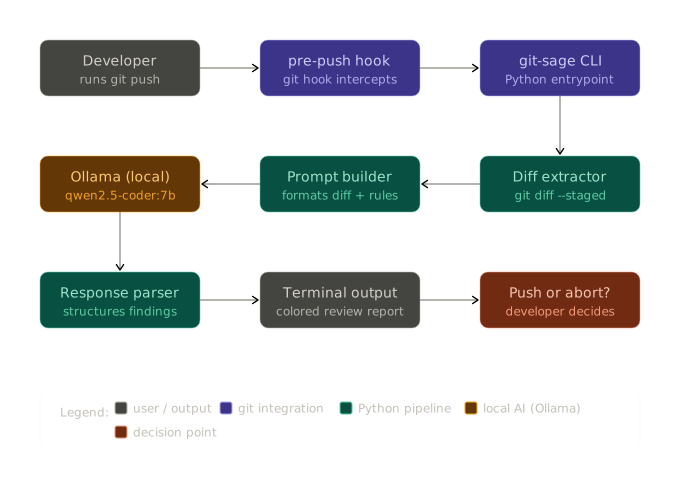
git-sage is intentionally simple. It has one job: take a git diff, send it to a local LLM, and render the result. There are no background services, no config files, and no state; just a linear pipeline that runs inside your git hook and exits cleanly in under 30 seconds.
High-level flow
git push
  └─► .git/hooks/pre-push
        └─► git-sage review --hook
              ├─► git diff --cached       → raw diff text
              ├─► build prompt            → system + user messages
              ├─► POST localhost:11434    → Ollama local API
              ├─► parse response          → structured ReviewResult
              ├─► render to terminal      → rich colored output
              └─► exit 0 (APPROVE) or exit 1 (REVISE → push aborted)
Module overview
The tool is split into six single-responsibility modules:
git_sage/
├── cli.py       Entry point; wires all modules together via Click commands
├── diff.py      Extracts the git diff using subprocess
├── prompt.py    Builds the system + user prompt from the diff
├── ollama.py    HTTP client for Ollama's local REST API
├── parser.py    Parses the structured LLM response into a ReviewResult
└── output.py    Renders the review to the terminal using Rich
And one utility module:
git_sage/
└── hook.py      Installs and removes the .git/hooks/pre-push script
Data flow in detail
1. Diff extraction (diff.py)
The diff is extracted by running git diff --cached as a subprocess. The output is a standard unified diff, the same format you see in GitHub pull requests.
The module parses the diff text to produce a DiffResult:
@dataclass
class DiffResult:
    raw: str           # full unified diff text
    file_count: int    # number of changed files
    additions: int     # lines added
    deletions: int     # lines removed
    files: list[str]   # changed file paths
2. Prompt building (prompt.py)
The prompt has two parts:
System prompt - tells the model how to behave: act as a senior code reviewer, return a structured response with four labelled sections (SUMMARY, ISSUES, SUGGESTIONS, VERDICT), focus on correctness and security, and never flag deleted lines.
User message - contains the diff stats, optional developer context, and the raw diff wrapped in a code block.
Keeping prompts in a dedicated module makes them easy to iterate on without touching the rest of the codebase.
3. Ollama API call (ollama.py)
ollama.py is a thin wrapper around Ollama's /api/chat endpoint using httpx. It sends the messages array and returns the model's response text.
Key settings:
temperature: 0.2- keeps responses deterministic and focusedtop_p: 0.9- slight diversity to avoid repetitive phrasing- Timeout: 120 seconds - enough for large diffs on CPU
payload = {
    "model": "qwen2.5-coder:7b",
    "messages": messages,
    "stream": False,
    "options": {"temperature": 0.2, "top_p": 0.9},
}
4. Response parsing (parser.py)
The system prompt instructs the model to use four labelled headings. The parser splits the response on those headings and extracts each section:
SUMMARY
<text>

ISSUES
1. <issue>
2. <issue>

SUGGESTIONS
1. <suggestion>

VERDICT
APPROVE | REVISE
The parser is tolerant of minor formatting variations: uppercase/lowercase headings, trailing colons, missing numbering. Since LLMs don't always follow instructions perfectly.
The output is a typed ReviewResult dataclass:
@dataclass
class ReviewResult:
    summary:     str
    issues:      list[str]
    suggestions: list[str]
    verdict:     Verdict     # APPROVE | REVISE | UNKNOWN
    raw:         str         # original LLM response
5. Terminal output (output.py)
The Rich library renders the result with coloured panels, bullet points, and a verdict badge. The spinner runs during the Ollama call to show the user something is happening.
6. Hook integration (hook.py)
The pre-push hook is a small shell script:
#!/usr/bin/env sh
# git-sage managed hook
git-sage review --hook
When the script exits with 0, git proceeds with the push. When it exits with 1 (REVISE verdict), git aborts the push and prints an error.
Design decisions
Why subprocess for git diff?
It's the simplest and most reliable approach. Git is always available in the environment where the hook runs, and git diff --cached has a stable, well-documented output format.
Why Ollama?
Ollama abstracts away model loading, quantization, and hardware acceleration behind a single HTTP API. Developers can swap models with one flag and run the same code on CPU, Apple Silicon, or NVIDIA GPUs without changing anything.
Why qwen2.5-coder:7b?
It's the best code-focused model that runs on consumer hardware. It understands unified diffs natively and consistently returns structured output. General-purpose models of the same size are noticeably worse at following the structured output format reliably.
Why httpx over requests?
httpx supports both sync and async usage with the same API. The sync path is used today; async support is a natural extension for streaming output without blocking.
Limitations
Context window limits
Every LLM has a maximum context window; the amount of text it can process in a single request. For qwen2.5-coder:7b, this is 32,768 tokens. A typical diff is well within this limit, but very large changesets (hundreds of files, thousands of lines) can exceed it.
If your diff is too large, Ollama will return a truncated or degraded response. To stay within safe limits:
- Review in smaller batches:
git adda subset of files before runninggit-sage review - Use
--diff-mode branchto review incrementally as you work rather than all at once - Break large features into smaller commits
A future version of git-sage could automatically chunk large diffs and aggregate the results.
Review quality depends on the model
The model flags what it can infer from the diff alone. It has no knowledge of your broader codebase; it can't see functions defined in other files, imported modules, or runtime behaviour. Issues that require cross-file context (e.g. a missing method defined elsewhere, or a race condition across two services) may not be caught.
Think of git-sage as a fast first pass, not a replacement for human review on critical code paths.
Structured output is not guaranteed
git-sage instructs the model to respond in a specific format (SUMMARY / ISSUES / SUGGESTIONS / VERDICT). Most of the time this works reliably with qwen2.5-coder:7b. Occasionally, especially with smaller or general-purpose models, the model may deviate from the format, resulting in an UNKNOWN verdict. The review is still shown, but the push is not aborted.
If you see frequent UNKNOWN verdicts, switch to a larger or more instruction-following model.
CPU inference is slow on large diffs
Without a GPU, inference time scales with diff size and model size. A small diff with qwen2.5-coder:7b takes 10–20 seconds on a modern CPU. A large diff with a 14B model can take several minutes. If speed is a concern, use a smaller model (qwen2.5-coder:3b) or invest in a machine with Apple Silicon or an NVIDIA GPU, where Ollama uses hardware acceleration automatically.